

By Jane Schuchardt
Special to the Elgin Review
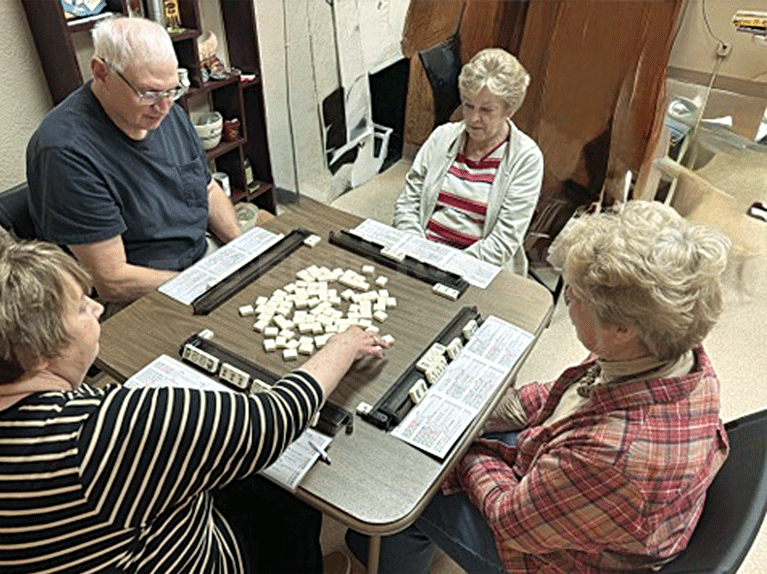
The sun glares into the east window of the Elgin Community Center while the tantalizing aroma of a homecooked meal wafts through the inside double doors from the dining room. Seated at tables of four, people from Elgin, Neligh, Clearwater, and Phoenix, AZ concentrate intensely, adamantly express excitement and disappointment, give it their all to hone skills, and build enduring friendships.
What’s happening? It’s mahjong, a tile-based table game dating back a couple centuries and gaining renewed popularity nationwide.
Janna Schrunk, center manager, invites anyone, any age, men and women to the center every Thursday at 12:30 pm (except the third Thursday when the game rolls on Tuesday) to learn and play mahjong. “Have lunch with us,” she said as she offered a cordial welcome. “Then participate in yet another activity the center offers to the community. Mahjong is something different and playing keeps cognitive skills going.”
And different it is! Consider a sampling of the language of the game – ‘bams, craks, dots, dragons, jokers’. Some tiles sport foreign-looking designs. Winning hands for the American version, which changes each year, are shown on a card available for purchase from the National Mah Jongg League.
The game is believed to have taken root in China in the 1800s, gaining popularity across Asia and other parts of the world. In the 1920s, the game spread to the United States and an English language rule book and version of the game, which differed somewhat from other countries, was developed. A group of Jewish-American women in New York organized the league in 1937 to standardize play here. The game is experiencing a resurgence in the United States amongst all ages.
The Elgin story originated with local resident Joyce Sullivan, who winters in Phoenix and brought her passion for the game home. “Margaret Jensen likes games,” Sullivan said, “so I called her.” Mary Jo Hoffman, Clearwater, has a similar story. “We moved back to the ranch from Sioux City, IA and I tried to find someone to play with.” Hoffman found Sullivan and local interest burgeoned.
The game room at the Elgin Community Center was an obvious choice to gather and now there can be as many as four tables of four each going strong at once. Play can be with two, three, or four people. Some even reported practicing at home by themselves or with spouses.
The group playing on a recent Thursday in October said mahjong was a lot like playing cards. Sharon Lilii described it this way, “You put together 14 tiles to create a hand to match one of the categories on the game card.” The first person to complete their 14-tile hand shouts ‘Mahjong’ and reveals tiles to win.
A single hand, or round, takes 10-15 minutes for experienced players to complete. The Elgin group generally takes a break at around 2:30 pm for “some brain food (candy),” according to Rhonda Jensen, Neligh. The afternoon of fast-paced fun wraps up about 3:30 pm when Margaret Jensen, Elgin, chimed in, “Our brains are done!” It’s widely accepted that mahjong supports brain health by engaging memory, pattern recognition, probability calculation, and strategic decision-making.
To take the edge off of learning mahjong, Al Hagemeister, who lives in Phoenix with his wife Ramona, took three-hour lessons once a week for six weeks. He shared, “It’s not easy. You have to study and know the tile combinations.” He and wife Ramona, who grew up here, spend summers in Elgin. She added that in some localities, the charge might be $100-300 for a series of lessons.
Margaret Jensen right away jumped in – “Play and learn here. It’s free! Everybody helps you.” In other words, the other players heartily welcome newcomers. “You can lose and still have fun,” Al Hagemeister said. “In Phoenix, the game is popular for both men and women. I wish more guys would play here.”
When asked ‘why play?’, the group offered a variety of convincing reasons. Rhonda Jensen, Neligh, said, “It’s educational, fun to meet people, see how the (Elgin) center is run, and I have to think!”
…..see more at this week’s Elgin Review.