
Sometimes an opportunity of a lifetime comes along, and we get to be part of something beyond ourselves, beyond our own family farm, and even beyond our own community. Such was the case for Anne and her husband Jim Meis as they traveled to Egypt this July and witnessed the impact of an educational program with the US Soybean Export Council (USSEC) that she has been involved with since 2022.
Mrs. Meis shared her story with The Elgin Review. This is a first-person account of their trip earlier this month.
It was back in 2022 that a random email came to me as a Nebraska Soybean Board Director, seeking a director to represent the Nebraska Soybean Checkoff as a new educational program was being developed for soybean end users.
The concept intrigued me as a former teacher who believes in the power of education, and I said yes. And so, the journey began that has taken me to Honduras, Peru, Cuba, India, Nigeria, and, most recently, Egypt.
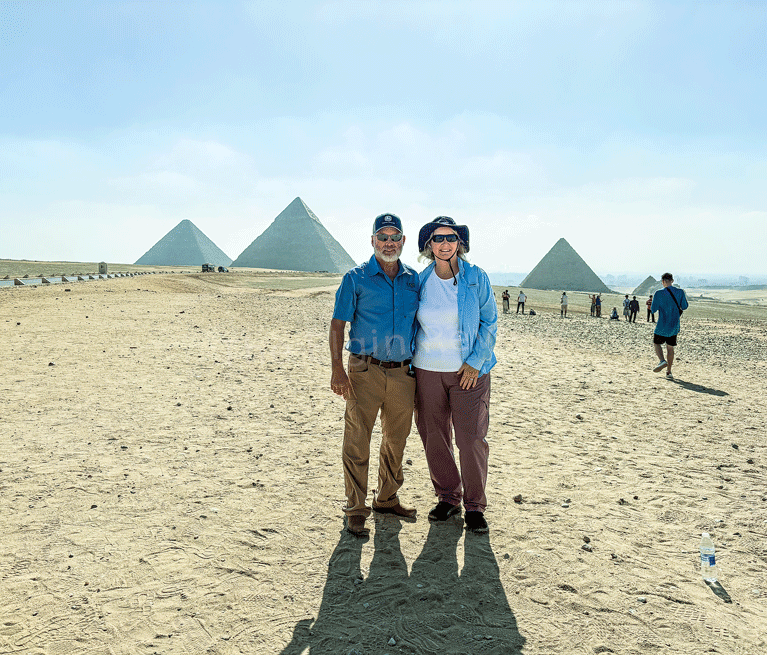
Although the purpose of our trip to Egypt was to promote US Soy to end users, it was also an amazing opportunity to tour Egypt’s rich ancient treasures. We were able to see pyramids, ride a camel, and visit the newly opened Grand Egyptian Museum. Another highlight of the trip was learning about the Coptic Christians who trace their roots to the early apostle St. Mark, who evangelized in Egypt.
We toured the cave where Mary, Joseph, and baby Jesus stayed when they fled to Egypt to avoid King Herod and saw the well from which the Holy Family drank. Jim toured an ancient Mosque and additional ruins, while I attended a large AquaCon Conference hosted by USSEC. The incredible link in our trip was always that soybeans grown right on our farm are exported for animal feed around the world, possibly even to Egypt to feed fish.
Egypt has long recognized the need for industrial development to address the country’s food security. The feed-to-animal protein conversion rate for a developing country is critical. Egyptian leaders recognized that the most efficient way to achieve food security and affordable animal protein was to develop poultry and aquaculture production.
Egypt is well positioned to import feed, with port cities and the Egyptian-owned Suez Canal. Over the last 10+ years, Egypt has developed a robust crushing industry, feed mills, and modern poultry barns and fish farms. In 2019, the time was right for Egypt’s protein industry to partner with the USSEC to develop training for those working in this rapidly expanding aquaculture and poultry industry. Funded by the soybean checkoff and USDA market access programs, the Soy Excellence Center (SEC) was established to provide hands-on training focused on the best global practices in aquaculture and poultry production.
Before 2006, fish were fed fishmeal diets. Two feed trials in 2006 transformed the industry by replacing high-cost fishmeal with soybean meal in the diet for the native Nile Tilapia. Soybean meal proved to be a high-quality protein source with an excellent amino acid profile and high digestibility for fish.
Because soybean meal offers a lower-cost, reliable year-round protein source, it has changed Egypt’s aquaculture industry. Egypt recognized that fish production would be the impetus for job creation, economic growth, and food security.
As fish production expanded, the need for aquaculture training became clear, leading to a partnership with U.S Soy to establish the SEC. This unique and innovative program developed practical, hands-on education for those who utilize and feed soy. Courses were developed in fish production, feed, and global best practices, drawing on local expertise.
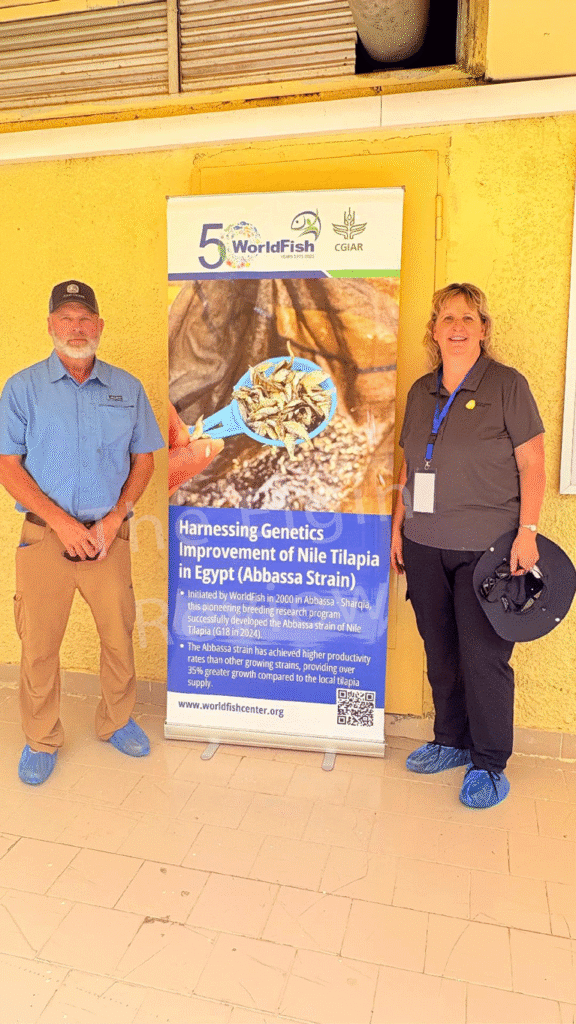
Egypt is home to WorldFish, a world-renowned research center for fish production, which is instrumental in improving aquaculture efficiency. Collaborating with WorldFish and Cairo University was critical to the success of the SEC.
As Egypt’s aquaculture industry has modernized, with continued support from programs such as the SEC, production has increased from 73,000 tons in 1997 to 1.6 million tons in 2024, according to Dr. Ahmed Nasr-Allah, director of WorldFish.
This exponential growth in aquaculture, coupled with a steady increase in poultry, has increased demand for soybean imports. Egypt is now the second-largest importer of whole US soybeans, behind China.
To learn more about this incredible growth in soybean imports and the work of the SEC, we traveled with a delegation of farmer leaders representing state soybean checkoff boards from Minnesota, Arkansas, Iowa, Illinois, and Indiana; the American Soybean Association; and the United Soybean Board.
During the visit, the delegation toured WorldFish and saw soybean meal pellets fed to Nile tilapia in modern pond-raceway systems that recycle water, which is then used to grow produce. Farmers met with trainees in an SEC intermediate aquaculture course being held at WorldFish, and a cake was cut to celebrate the 7-year anniversary of the SEC.
I was overwhelmed by the show of appreciation for our delegation of US soybean farmers for providing this education and for helping provide food for a growing population. Trainees told me that they have learned valuable skills, implemented new practices, and are now valued by their companies. In a country like Egypt, where the average income is $4000/ a year, it is important to provide jobs and affordable protein.
As income levels rise, demand for protein will continue to grow, and US soybeans can be positioned to meet that demand.
Due to the success of the SEC in Egypt, similar Soy Excellence Centers have been established in Latin and Central America, India, Asia, and Nigeria. Courses are offered in poultry, aquaculture, swine, feed production, dairy, and soy foods.
As the SEC continues to drive progress, US Soy farmers, working with the protein industry, can help create a brighter future and build long-term relationships. The SECs are improving lives through education and helping create loyalty and demand for US Soy. It is a win-win.
This is a soybean checkoff-funded success story, and it is an immense privilege to be a part of this journey.