

Farming is steeped in the tradition of sharing various practices and improving upon them. Organic farming is no exception to that tradition.
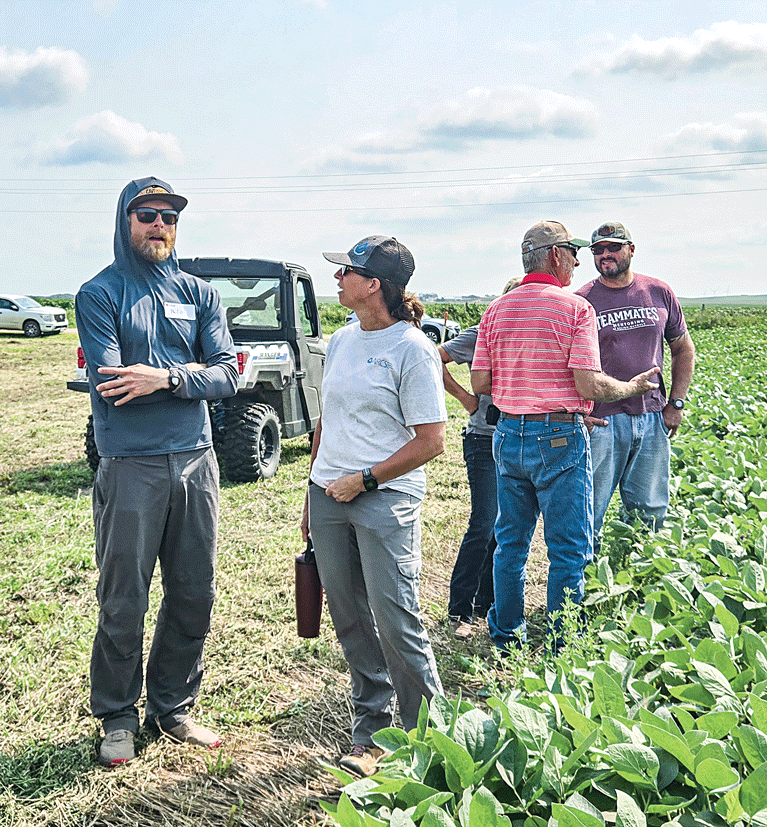
On Friday morning, August 7th, approximately 30 farmers and farm-adjacent business representatives traveled to the Rick and Jane Schuchardt farm located northeast of Elgin. There, Philip Schuchardt (son of Rick and Jane) guided them on a field tour of the family’s organic farm and led a lively discussion on the methods they use in their organic fields, what works well and what hasn’t worked quite so well. There was a good amount of give-and-take as attendees asked questions and shared their experiences in using various equipment and methods.
“I started farming maybe 3 or 4 years ago,” Philip said as he began the tour. “My dad’s been doing it since 2003. I used to work for a aerospace company doing software engineering so I kinda come to farming with a engineering mindset.”
He noted that, by doing even a small amount of research, you will find out that plowing is “not great for your soil structure”. As he put it, “the problem with organic farming is weed control”.
Conventional farming controls weeds with spraying. “Days and hours matter when you cultivate,” he explained. “So I was looking for other methods … how can we reduce the amount of plowing, get rid of plowing or do no-till for organics? That’s the dream maybe. I think what we are really going after is reduce till organics. It’s hard to do organics without cultivation.”
As the group viewed the soybean fields – and corn – Philip pointed out different areas where different methods of weed control, crop rotation and cover crops were utilized. He spoke at length of roller “crimping”. A roller-crimper is a heavy drum which rolls over cover crops, crushing (crimping) the cover crop down. That crimped crop then creates a “mat” over the soil surface.
As he explained, they are continually experimenting to discover the best times (growing stages, weather conditions, time of day) and field conditions (smooth soil, ridges, field debris) to crimp their fields. For their 2026 crop, they planned to do 3 different methods: 1) drill 6-inch rows of soybeans, then rotary-hoe and tine-weed those rows; 2) cultivate the beans, but ended up not doing that; and 3) do a 1-acre crimp test. Instead of 1 acre, they did 15 acres because of weather. Alongside the fields, he showed and spoke of the differences in the two methods that they ultimately did.
“With farming, you are always at the hands of Mother Nature.”
Field to barn
Following the tour of the corn and soybean fields, the tour group moved inside. At the family’s restored barn, attendees were treated to a catered noon meal and the discussion continued. Two slide shows were played as Rick narrated the images that chronicled their growing season so far.
The organic farm tour was sponsored by the Nebraska Extension Office and the Organic Crop Improvement Association (OCIA), Nebraska Chapter.
Anyone with further questions and wanting to learn more about organic farming is welcome to contact the Schuchardt family or visit https://www.nebraskaocia.org for more information on organic farming in Nebraska.